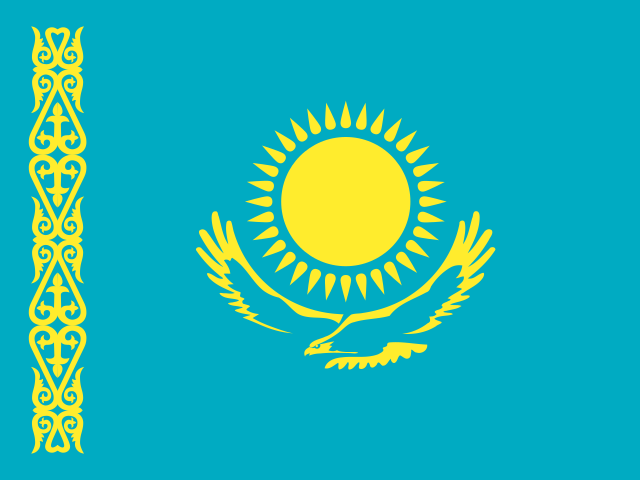
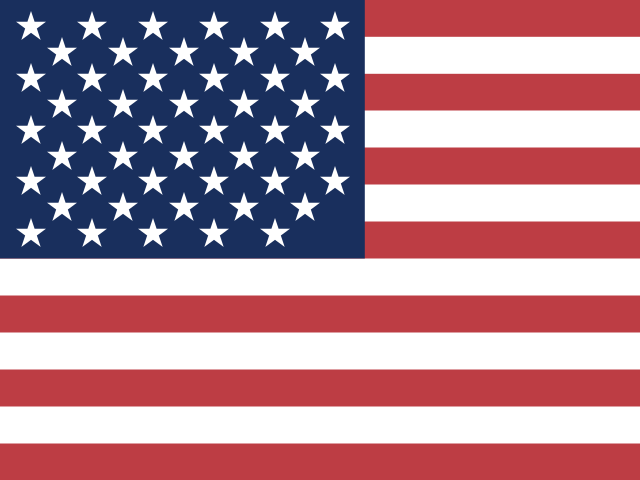
The duel
Land
Size, shape and altitude
How big is it, really?
Kazakhstan fits inside the United States 3.6 times.
Kazakhstan: 2,724,900 km² (2023) · United States: 9,831,510 km² (2023)
How much coast is there?
Kazakhstan: 0 km (2026 edition) · United States: 19,924 km (2026 edition)
How high can you climb?
Kazakhstan’s highest peak towers 820 m above the United States’.
Kazakhstan: 7,010 m (2026 edition) · United States: 6,190 m (2026 edition)
People
Who lives there, and how closely
How many people live there?
The United States has 16 times as many people as Kazakhstan.
Kazakhstan: 20.8 million (2025) · United States: 342 million (2025)
How crowded is it?
The United States is 4.8 times as densely populated as Kazakhstan.
Kazakhstan: 8 per km² (2025) · United States: 37 per km² (2025)
How tall are the men?
Men in the United States are 1.4 cm taller than in Kazakhstan.
Kazakhstan: 175.5 cm (2019) · United States: 176.9 cm (2019)
How tall are the women?
Women in the United States are 1.6 cm taller than in Kazakhstan.
Kazakhstan: 161.7 cm (2019) · United States: 163.3 cm (2019)
How old is the typical person?
The typical person in the United States is 8.6 years older than in Kazakhstan.
Kazakhstan: 29.5 years (2023) · United States: 38 years (2023)
How many children per woman?
Women in Kazakhstan have 1.4 more children on average than in the United States.
Kazakhstan: 2.98 children per woman (2024) · United States: 1.63 children per woman (2024)
How many people are 65 or older?
18% of people in the United States are 65 or older, versus 9.0% in Kazakhstan.
Kazakhstan: 9% (2025) · United States: 18.4% (2025)
How many Nobel laureates were born there?
The United States has produced 8.7 Nobel laureates per 10 million people, Kazakhstan 0.0.
Kazakhstan: 0 (2025) · United States: 8.7 (2025)
How many official languages?
Kazakhstan has 2 official languages, the United States 1.
Kazakhstan: 2 (2026) · United States: 1 (2026)
Money
What an economy looks like per person
How big is the economy?
The United States’ economy is 100 times the size of Kazakhstan’s.
Kazakhstan: $306 billion (2025) · United States: $30.8 trillion (2025)
How much is produced per person?
The United States produces 2 times as much per person as Kazakhstan.
Kazakhstan: Int$44,294 (2025) · United States: Int$90,027 (2025)
How evenly is income shared?
Income is more unequally shared in the United States than in Kazakhstan (Gini 12.6 points higher).
Kazakhstan: 29.2 (2021) · United States: 41.8 (2024)
How many people are looking for work?
Unemployment is 4.8% in Kazakhstan, versus 4.2% in the United States.
Kazakhstan: 4.8% (2025) · United States: 4.2% (2025)
How much goes to the military?
The United States spends 3.4% of its GDP on the military, Kazakhstan 0.4%.
Kazakhstan: 0.4% (2024) · United States: 3.4% (2024)
How expensive is it?
The United States’ price level (US = 100) is 3× Kazakhstan’s.
Kazakhstan: 33% (2025) · United States: 100% (2025)
Health
Long lives, small beginnings
How much is spent on health?
The United States spends 28 times as much on health per person as Kazakhstan.
Kazakhstan: $490 (2023) · United States: $13,473 (2023)
How long do people live?
People in the United States live 4.4 years longer than in Kazakhstan.
Kazakhstan: 74.5 years (2024) · United States: 78.9 years (2024)
How many babies don’t reach their first birthday?
A baby in Kazakhstan is 35% more likely to die before turning one than in the United States.
Kazakhstan: 7.4 per 1,000 (2024) · United States: 5.5 per 1,000 (2024)
How many doctors are there?
Kazakhstan has 2% more doctors per person than the United States.
Kazakhstan: 3.8 per 1,000 (2023) · United States: 3.7 per 1,000 (2022)
How common is obesity?
42% of adults in the United States are obese, versus 22% in Kazakhstan.
Kazakhstan: 22.4% (2024) · United States: 41.8% (2024)
How many adults smoke?
21% of adults in Kazakhstan smoke, versus 16% in the United States.
Kazakhstan: 21.1% (2024) · United States: 15.8% (2024)
Everyday life
Plates, glasses and happiness
How do people rate their lives?
People in the United States rate their lives 0.18 points higher than in Kazakhstan.
Kazakhstan: 6.63 (2025) · United States: 6.82 (2025)
How much do people drink?
Adults in the United States drink 60% more alcohol than in Kazakhstan.
Kazakhstan: 6 litres (2023) · United States: 9.6 litres (2023)
How much meat is on the menu?
The United States has 88% more meat per person than Kazakhstan.
Kazakhstan: 64.9 kg (2023) · United States: 122.1 kg (2023)
How much food is there per day?
The United States has 811 kcal more food per person per day than Kazakhstan.
Kazakhstan: 3,136 kcal (2023) · United States: 3,947 kcal (2023)
How long do people work?
Workers in Kazakhstan put in 186 more hours a year than in the United States.
Kazakhstan: 1,975 hours (2023) · United States: 1,789 hours (2023)
How long do people go to school?
Adults in the United States went to school 1.4 years longer than in Kazakhstan.
Kazakhstan: 12.5 years (2023) · United States: 13.9 years (2023)
How many tourists visit?
Kazakhstan welcomed 2.4 times as many tourists per resident as the United States (2019).
Kazakhstan: 0.5 (2024) · United States: 0.21 (2024)
Connected
Online, electrified, urban
How many people are online?
95% of people in the United States are online, versus 93% in Kazakhstan.
Kazakhstan: 93% (2024) · United States: 95% (2024)
Who has electricity at home?
Kazakhstan and the United States are practically level.
Kazakhstan: 100% (2024) · United States: 100% (2024)
How many live in cities?
80% of people in the United States live in cities, versus 62% in Kazakhstan.
Kazakhstan: 62% (2025) · United States: 80% (2025)
How many phones per person?
Kazakhstan has 127 mobile subscriptions per 100 people, the United States 113.
Kazakhstan: 127 (2024) · United States: 113 (2024)
How much railway is there?
The United States’ railway network is 9.3 times as long as Kazakhstan’s.
Kazakhstan: 16,006 km (2021) · United States: 148,553 km (2021)
How much do they fly?
Airlines from the United States fly 4.8 times as many passengers per resident as those from Kazakhstan.
Kazakhstan: 0.57 (2023) · United States: 2.75 (2023)
Planet
Air, forests and energy
How much of the land is forest?
Forest covers 34% of the United States, but only 1.3% of Kazakhstan.
Kazakhstan: 1.3% (2023) · United States: 33.9% (2023)
How much CO₂ does each person emit?
The average person in the United States emits 2% more CO₂ than someone in Kazakhstan.
Kazakhstan: 13.9 t (2024) · United States: 14.2 t (2024)
How green is the power grid?
26% of the United States’ electricity is renewable, versus 15% in Kazakhstan.
Kazakhstan: 14.9% (2025) · United States: 25.6% (2025)
How clean is the air?
The air in Kazakhstan carries 2.1 times as much fine dust as in the United States.
Kazakhstan: 16 µg/m³ (2024) · United States: 7.5 µg/m³ (2024)
Safety
Measured risk, not vibes
How common is murder?
You are 2.3 times as likely to be murdered in the United States as in Kazakhstan.
Kazakhstan: 2.6 per 100k (2022) · United States: 5.8 per 100k (2023)
How dangerous are the roads?
Roads in the United States are 16% deadlier than in Kazakhstan.
Kazakhstan: 12.2 per 100k (2021) · United States: 14.2 per 100k (2021)
Climate
What the year feels like
How warm is it?
The United States is on average 2.5 °C warmer than Kazakhstan.
Kazakhstan: 7.8°C (2016–2025 avg) · United States: 10.3°C (2016–2025 avg)
How much rain falls?
The United States gets 2.6 times as much rain as Kazakhstan.
Kazakhstan: 328 mm (2016–2025 avg) · United States: 849 mm (2016–2025 avg)
Quick answers
Is Kazakhstan bigger than the United States?
The United States is larger. Kazakhstan fits inside the United States 3.6 times.
Which has more people, Kazakhstan or the United States?
The United States has 16 times as many people as Kazakhstan (2025 estimates).
Where do people live longer, Kazakhstan or the United States?
People in the United States live 4.4 years longer than in Kazakhstan. Life expectancy at birth is 74.5 years in Kazakhstan and 78.9 in the United States.
Are people taller in Kazakhstan or the United States?
Men in the United States are 1.4 cm taller than in Kazakhstan (NCD-RisC, cohort born 2019).